AIRS: The Human Layer of AI Adoption | AI Wars of 2026
How the human conditions of readiness, value, and trust shape AI adoption.
AIRS: The Human Layer of AI Adoption
AI availability is not the same as adoption. A capable model, a broad distribution channel, or a well-designed agent can make AI available to people, but each still has to become useful enough, trusted enough, and worthwhile enough to enter a real workflow.
Big Idea
AI adoption has a psychological dimension, not only a skills dimension: training alone may not overcome a value-perception barrier.
This page draws on the AI Readiness Scale (AIRS), a doctoral research project that examined AI adoption intention in a U.S. sample of academic and professional participants. AIRS does not measure technical skill directly. It measures readiness conditions that can influence whether available AI becomes a practice. Source 1
Research lineage
AIRS extends the Unified Theory of Acceptance and Use of Technology (UTAUT) and UTAUT2, foundational models of technology adoption developed by Dr. Viswanath Venkatesh and colleagues. Source 2 Source 3 Dr. Venkatesh served as the author's mentor during the dissertation's development. That relationship provides research context for AIRS. However, it is not an endorsement of this web-book or AIRS Enterprise.
In a later research agenda, Dr. Venkatesh identifies adoption and use of AI tools as a distinct area for study. Source 4 AIRS takes that question into a specific U.S. academic and professional sample, where readiness and behavioral intention can be examined alongside AI's distinctive context.
From availability to repeated use
The visual separates four questions. Availability gives a person access to AI; readiness concerns the human conditions for trying it; workflow use tests whether it fits the surrounding task and organization; and the decision point asks whether continued use feels worth the effort. A yes makes repeated use and an observable outcome possible. A no should trigger reassessment, not an automatic assumption that people simply need more instruction.
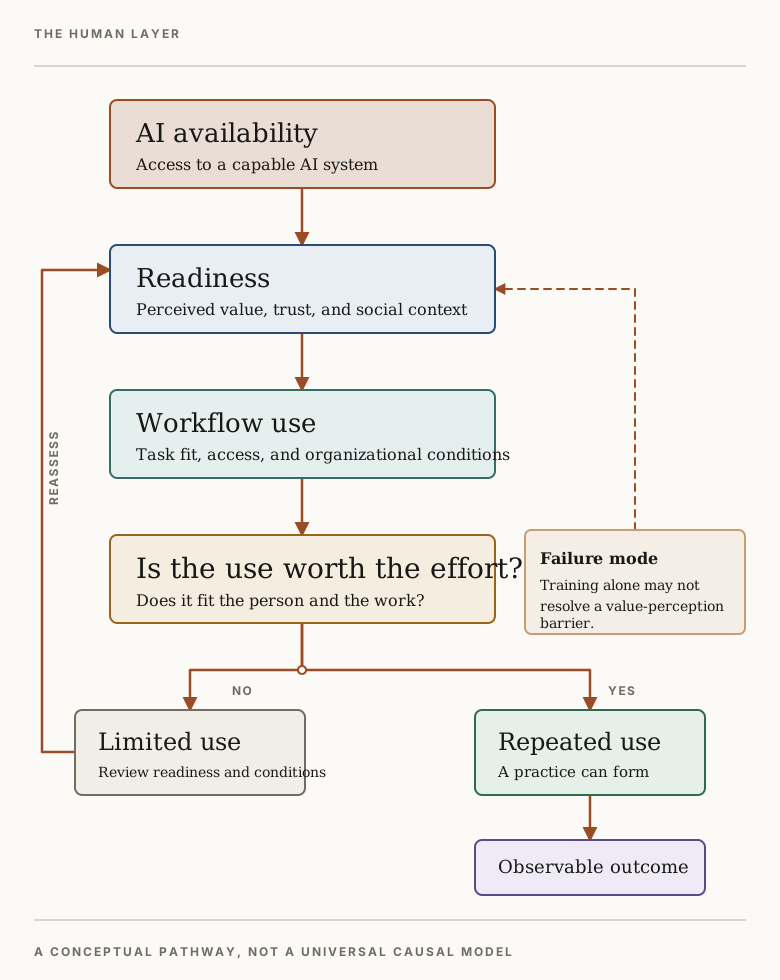
The book's distribution argument therefore needs a human test. A product can reach many people without becoming a repeated practice, and repeated use can still fail to produce a valuable outcome. The question is where readiness and workflow conditions change that path.
Why a skill-gap diagnosis can fail
Training and readiness are not opposites. Training can build capability, reduce uncertainty, and support a person facing a genuine skill or access gap. But it cannot be assumed to solve every adoption problem.
The AIRS model examined facilitating conditions, including access to training or tutorials and compatibility with other tools. When those conditions were considered alongside other readiness dimensions, they did not independently predict behavioral intention in the study. Perceived price value—the judgment that AI is worth the time, effort, or cost it requires—was the strongest reported predictor. Source 1
That contrast supports the failure mode in the visual. When the barrier is value perception, more training alone may leave the central question unanswered: why should this person continue using AI in this workflow? It does not mean training is ineffective, nor that value perception explains every adoption decision.
What AIRS suggests
The study developed and validated a 16-item, eight-dimension readiness instrument through split-sample exploratory and confirmatory analysis of 523 U.S. academic and professional participants. The measurement model showed strong fit in the holdout sample. This supports the instrument as a way to examine distinct readiness conditions; it does not turn any one condition into a universal explanation. Source 1
The chart shows the reported predictors of AI adoption intention in this U.S. sample. Price Value was robust in bootstrap testing. Hedonic Motivation and Social Influence were significant in the model's z-tests but sensitive to sample composition. Source 1
These are standardized model coefficients for stated behavioral intention. They do not measure actual use, productivity, retention, technical skill, or the likely success of an organization's AI deployment.
What did not yet provide a robust signal
The study did not find independent effects for Performance Expectancy, Effort Expectancy, Facilitating Conditions, or Habit when they were considered with the other dimensions in the model. Facilitating Conditions included access to training or tutorials and tool compatibility. AI Trust was marginal (β = .106, p = .064): it did not reach conventional significance, so it remains an important dimension to test rather than an established predictor in this study. Source 1
The AIRS-16 retains these validated dimensions for future testing across cultures, markets, and AI-use scenarios beyond the original U.S. sample. Their predictive roles may differ where social norms, policy environments, economic conditions, or the consequences of AI use change. A future AIRS-8 could be considered only if cross-market validation shows that a shorter instrument preserves the measurement quality and diagnostic usefulness needed for its purpose.
What this adds to AI Wars
The AIRS evidence establishes the human layer as necessary to this book's adoption analysis. People do not encounter AI as abstract capability: they assess whether it is worth the cost and effort, whether its use fits the work around them, and whether people they trust support its use. Chapter 00, The Human Agency Imperative, places that evidence within the book's wider strategic argument.
This does not turn readiness into a complete explanation. The cross-sectional U.S. study cannot establish causal order, generalize its effects across countries or sectors, or show that an intervention changes adoption. It measures behavioral intention, not durable use or business value. Source 1
The claim would be stronger if longitudinal, multi-market research showed that readiness profiles predict observed, repeated use and that value-focused responses outperform training-only responses when value perception is the barrier. It would be weakened if those patterns did not hold outside the original sample or if training access consistently explained adoption once actual behavior was measured.
The next evidence questions are practical: when does perceived value become observed workflow value; how do trust and authority matter as AI moves from answers to consequential action; and which organizational conditions enable people to use AI without losing meaningful control?
AIRS Enterprise
AIRS Enterprise is a separate, optional self-assessment based on the AIRS research. It provides a readiness profile and personalized recommendations for an individual's situation. Source 5
Five readiness dimensions did not provide a robust independent signal
Reported standardized coefficients for four non-significant dimensions and marginal AI Trust in the AIRS U.S. academic and professional sample (N = 523).
Big Idea: Within the AIRS study's U.S. sample, Performance Expectancy, Effort Expectancy, Facilitating Conditions, and Habit did not independently predict behavioral intention; AI Trust was marginal rather than established.
| Readiness dimension | Label | Standardized coefficient (β) | Value Label |
|---|---|---|---|
| Performance expectancy | Performance expectancy | -0.028 | β = -.028 (ns) |
| Effort expectancy | Effort expectancy | -0.008 | β = -.008 (ns) |
| Facilitating conditions | Facilitating conditions | 0.059 | β = .059 (ns) |
| Habit | Habit | 0.023 | β = .023 (ns) |
| AI Trust | AI Trust | 0.106 | β = .106 (marginal) |
The chart transcribes the reported coefficients for Performance Expectancy, Effort Expectancy, Facilitating Conditions, Habit, and AI Trust. Facilitating Conditions included access to training or tutorials and tool compatibility. The zero baseline distinguishes positive from negative coefficients.
AI Trust was marginal (p = .064), while the other four dimensions were non-significant. These results do not establish that any dimension never matters, and the cross-sectional U.S. sample does not measure technical skill, actual use, productivity, retention, or causal effects.
Perceived value was the robust predictor of adoption intention
Reported standardized coefficients for the z-test-significant readiness dimensions in the AIRS U.S. academic and professional sample (N = 523).
Big Idea: Within the AIRS study's U.S. sample, Price Value was the robust reported predictor of behavioral intention; Hedonic Motivation and Social Influence were suggestive but sample-sensitive.
| Readiness construct | Label | Standardized coefficient (β) | Value Label |
|---|---|---|---|
| Price value | Price value | 0.505 | β = .505 |
| Hedonic motivation | Hedonic motivation | 0.217 | β = .217 |
| Social influence | Social influence | 0.136 | β = .136 |
The chart transcribes the three z-test-significant coefficients from the AIRS structural model. Values are not percentages and cannot be interpreted as effect sizes across other studies.
Price Value was robust in 1,000 bootstrap resamples. Hedonic Motivation and Social Influence had bootstrap confidence intervals that included zero, and the cross-sectional sample does not establish causation or generalizability.
Source references
Source 1: Artificial Intelligence Readiness Scale: Extending UTAUT2 for Enterprise AI Adoption
Touro University Worldwide / Fabio Correa
Published: 2026-04
Doctoral dissertation reporting validation of AIRS-16 using a U.S. academic and professional sample (N = 523). Its cross-sectional findings support sample-bounded associations with behavioral intention, not universal causal effects, realized adoption, productivity, retention, or business value.
Source 2: User Acceptance of Information Technology: Toward a Unified View
MIS Quarterly
Published: 2003
Venkatesh, Morris, Davis, and Davis introduced UTAUT as a unified model of technology acceptance and use. It is a theoretical foundation for AIRS, not evidence for AI-specific adoption outcomes.
Source 3: Consumer Acceptance and Use of Information Technology: Extending the Unified Theory of Acceptance and Use of Technology
MIS Quarterly
Published: 2012
Venkatesh, Thong, and Xu extended UTAUT to UTAUT2. AIRS uses its constructs as a theoretical foundation while testing an AI-specific instrument in a separate study.
Source 4: Adoption and Use of AI Tools: A Research Agenda Grounded in UTAUT
Annals of Operations Research
Published: 2021
Viswanath Venkatesh's research agenda applies UTAUT to the study of AI-tool adoption. It frames research questions; it does not independently validate AIRS or its findings.
Source 5: AIRS Enterprise self-assessment
CorreaX
Published: 2026
Public product page for the separate AIRS Enterprise self-assessment. It describes an assessment and personalized recommendations; it is product documentation, not independent evidence that recommendations improve adoption or outcomes.